


Table of Contents
The age-old debate over whether using the sync button makes you a bad DJ continues to spark heated discussions in booths and specialist forums alike. In our experience training new talent behind the decks, hitting the sync button has never defined a selector’s technical or musical worth. The player’s processor merely calculates a tempo algorithm; it makes no stylistic decisions, nor does it grasp the pulse of the dance floor.
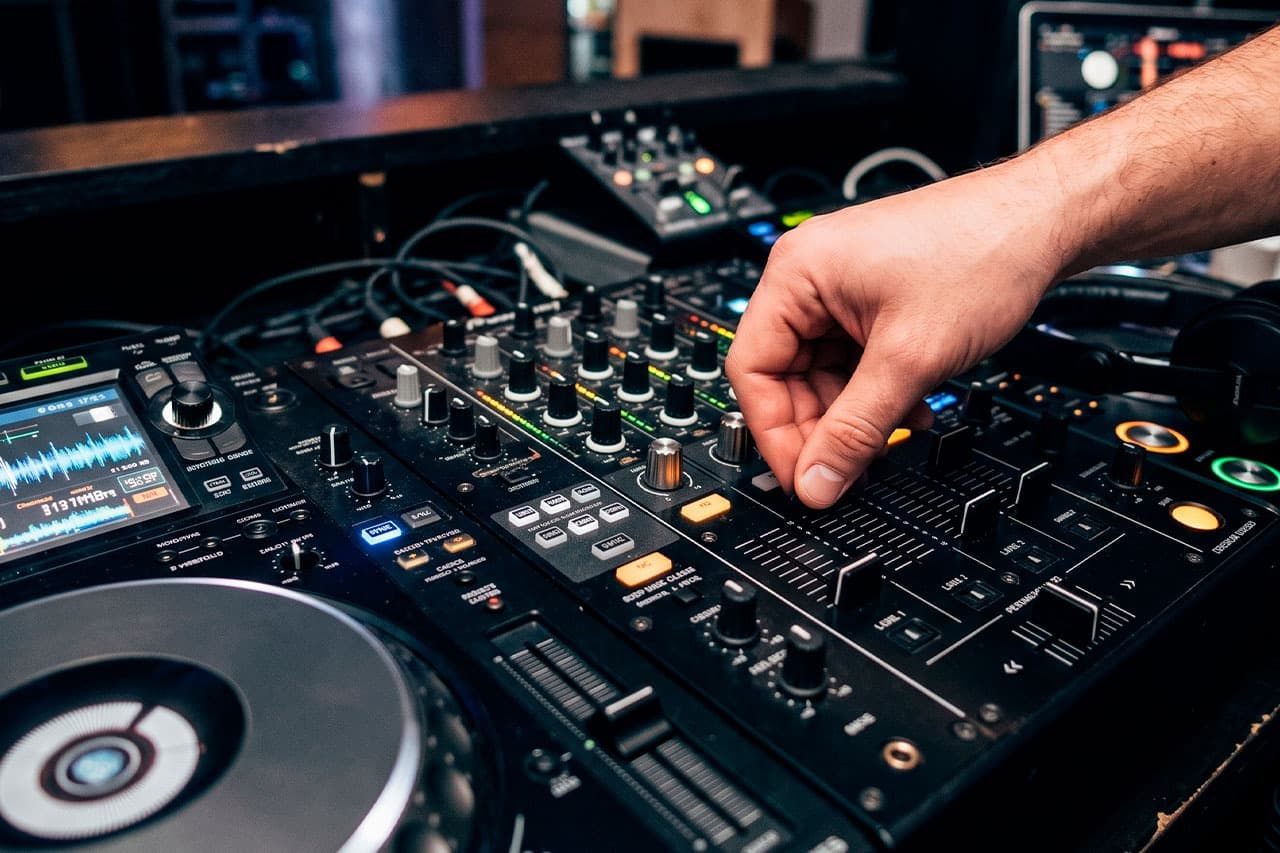
The issue arises when you try to sort out a mix by outsourcing your ears to the screen. When a beginner believes that having two waveforms perfectly lined up is the same as knowing how to DJ, the foundations of the set start to crack. Relying on visual aids often masks severe shortcomings in EQ and frequency management, internal rhythm, and reading the room. If you want to convey true authority in a demanding club environment, these are the habits you need to stamp out from the get-go.
Common mixing mistakes that destroy coherence in the booth
Living in the red on the VU meter (red-lining)
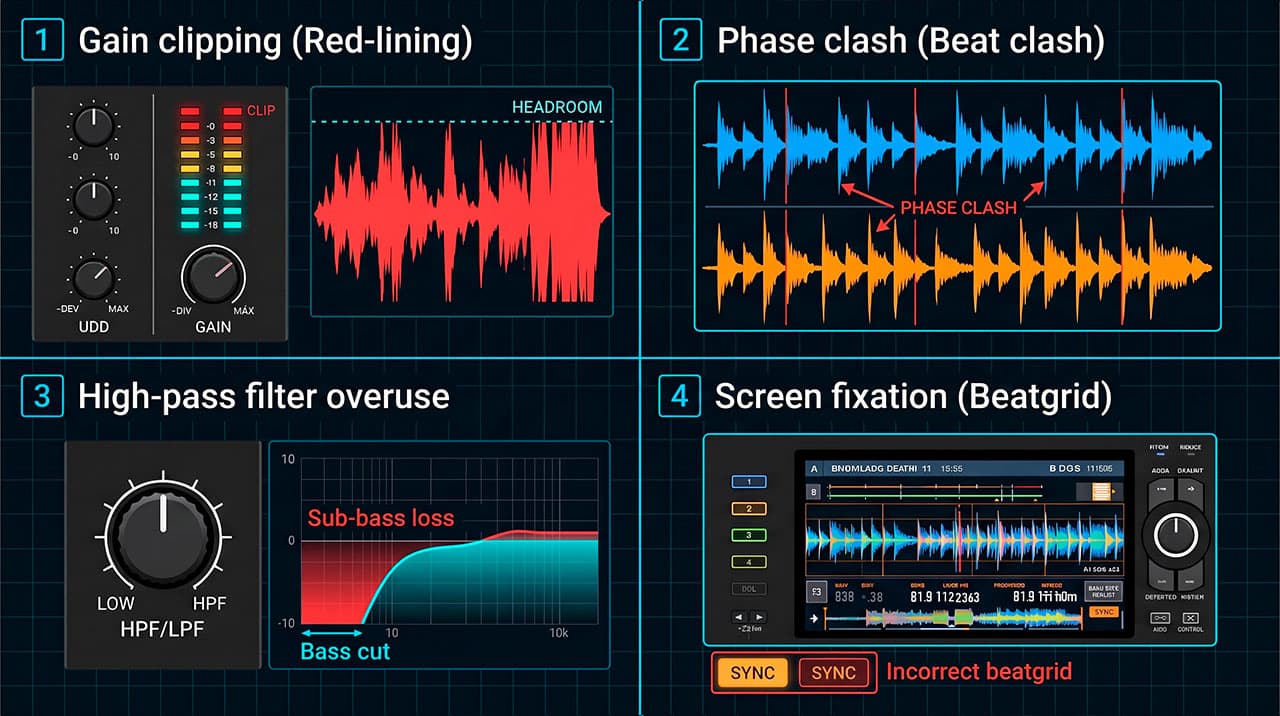
Seeing the channels clipping in bright red remains one of the common mixing mistakes most widespread in amateur booths. Gain is systematically confused with actual loudness. When cranking the trim sin control para buscar impacto, la señal entra recortada al mixer, dispara los limitadores del procesador de la sala y aplasta por completo el headroom. The result is an unintelligible mush, immediate ear fatigue for the crowd, and the justified annoyance of the sound engineer. Keeping the meters breathing in the amber preserves the clean punch of the kick and the clarity of the sub-bass.
Ignoring musical phrasing and the natural breathing of the bar
Syncing 4/4 beats doesn’t mean matching the music. Club electronics are built around 16- and 32-beat phrases, where arrangements, drops, and breakdowns follow a strict narrative. This is where many selectors trip up: they drop the incoming track halfway through a phrase simply because the beatmatching looks spot on the screen. This usually goes wrong when planning is left to the final bar without listening for the incoming tune’s shifts in tension. Snares clash, basslines collide, and the dance floor’s energy grinds to a dead halt.
Overusing the high-pass filter as a transition crutch
The high-pass filter is an excellent expressive tool, but leaning on it systematically to get out of any sonic muddle betrays a lack of EQ technique. Stripping the body from the incoming kick with the filter and suddenly dropping it back in on the downbeat is usually the easy way out to dodge frequency masking. Overusing this trick drains the dance floor of bass bar after bar, breaking the set’s physical tension. A smooth, deep transition is crafted by precisely sculpting the traditional EQ bands, without deflating the room’s sound.
Mixing with your eyes glued to the waveform
Modern media players and software screens offer a staggering amount of visual data, but DJing isn’t a desk job. Staring at the display to check whether the beat grid lines up disconnects you from the only thing that truly matters: how the room reacts to every shift in tone. The human ear detects phase issues and acoustic cancellation that no spectral display will ever warn you about in time.
Beginner DJ techniques: practical exercises for the home studio
Regaining muscular and auditory control means stripping away artificial crutches. If you want to master beginner DJ techniques that give you genuine composure to tackle any booth without breaking into a cold sweat, build these habits into your practice sessions:
- Blind training:Cover the CDJ screens or close your laptop lid to force yourself to find the cue point and tempo using only headphone monitoring.
- Cue gain staging: Calibrate the gain on the incoming channel by matching its peak level against the master track before touching the line fader.
- Clean three-band transition:Execute complex transitions by manipulating strictly lows, mids, and highs on the EQ, doing away entirely with FX knobs and color filters.
Dominar estos fundamentos te da la tranquilidad necesaria para subir a cualquier cabina, leer la pista con soltura y construir un discurso propio. Conoce más sobre nuestra filosofía de formación en cabina visitando la sección about us and discover how we tackle technique from the very first beat.
Is it bad to use the sync button during a live set?
Using the sync button is not detrimental provided it is used as a workflow tool to speed up three- or four-deck transitions, rather than as a stopgap to cover up poor listening skills. The issue is not the automation itself, but the inability to sort out the mix when the track’s beatgrid hasn’t been properly analysed.
Why does the mix sound muddy even though the BPMs match?
The primary cause is the overlap of low frequencies in the spectrum. Leaving two kicks or two basslines running at the same level without EQ cutting cancels out the sub-bass and muddies the mix. Furthermore, coming in out of phase builds up energy on the VU meters without providing any rhythmic clarity.
How to manage FX sends without cluttering the set?
Effects should complement the track’s groove, never mask a phrasing error or harmonic clash. Keep the dry/wet control below fifty percent and cut delays or reverbs before the main kick of the incoming track drops.
Join Beatheim
As you can see, mastering a club booth demands an intimate grasp of signal flow, musical structure, and frequency management on the floor. Experiencing electronic music from behind the decks completely shifts your perspective on sound dynamics and live mixing, both with and without the sync button. If your goal goes beyond simply being a listener to performing with fluency and distinct character in any professional booth, consistent technical training is your greatest asset. If you want to refine your technique, weed out bad listening habits, and handle club gear with absolute confidence, book your one-to-one session at our beginner module and practise side by side with us. See you on the dance floor!
Join the Beatheim Community!
Get ready to take your sets to the next level at Beatheim DJ Academy!